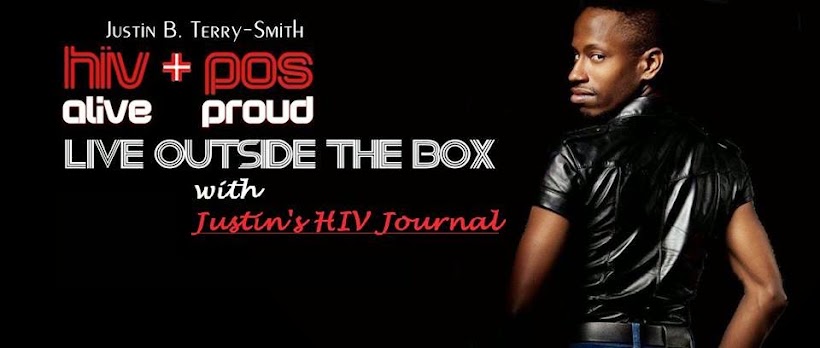
Justin B. Terry-Smith has been involved in LGBTQ and HIV Activism since 1999. He is an Air Force 9/11 Disabled Vet. Raised in Silver Spring, MD, he now lives in Albuequerque, New Meixco with his husband Phil. He writes an HIV/STI Advice Column for A&U Magazine, is a Contributing writer for thebody.com, a Life Coach and an Adjunct Professor. He has earned his Doctorate in Public Health with a concentration in Infectious Disease and his Masters in Clinical Mental Health Counseling.
Friday, February 7, 2014
Justin B Terry-Smith's Justin's HIV Journal #HAAwards Nomination
Justin B Terry-Smith's Justin's HIV Journal #HAAwards
Nomination
https://awards.wegohealth.com/nominees/justin-1736


Justin's HIV Journal: Justin B Terry-Smith tackles HIV and Aging
Justin's HIV Journal: Justin B Terry-Smith tackles HIV and Aging
Baltimore Gay life Newspaper
http://issuu.com/baltimoregaylife/docs/gaylife_february2014/18
Baltimore Gay life Newspaper
http://issuu.com/baltimoregaylife/docs/gaylife_february2014/18
Sunday, February 2, 2014
Justin's HIV Journal: Justin and husband Phil ADOPT son
ADOPTION DAY is finally here. On January 30th my husband Dr.
Philip Terry-Smith adopted our 17 year old LGBT son.
When I became HIV positive I thought to myself, “I will
never have a child”. I cried so much over this every time I thought about
it. Every time I saw a child with their parent
playing, walking hand in hand, giggling, just being a family it hurt, it hurt
me to my soul.
When my husband asked me to marry him, I said yes but I have
provisions. I stated that I would like
to have children. I made a command decision
in my life that I would have kids. I
also said that I need a man that would want to have children with me. My husband (THANK THE GODS) agreed that
children would be a part of our future.
I can honestly say our son has come such a long way being
with us. When he first came to us he was
15 years old he was not what I expected a 15 year old to be. But then I had to realize I did not raise
this child; so I made it my goal to make him a little more refined and to bring
more structure and discipline into his life.
He has a story and I’m not the one to tell it. So I will briefly say that this young man has
been through the ringer. But now that he
has a loving and supportive family he is stronger than before.
Phil, my son and I went to court and we have legally made
him ours. He will forever be ours and I wouldn’t
want it any other way
Saturday, February 1, 2014
Justin's HIV Journal: Justin B. Terry-Smith on Spill Da Tea with Shi Queeta Lee
Justin B Terry-Smith-HIV, Diamond Alexis Blue-Legal Blindness, Ryan Dillon- Epilepsy, Tamika Felder- Cervical Cancer, SaVanna Wanzer- Community Activist
Friday, January 3, 2014
Just*in Time (HIV Advice Column): Thrush, HIV Strains, and Who Infected me with HIV
Just*in Time (HIV Advice Column): Thrush, HIV Strains, and Who Infected me with HIV
Hey Justin,
I was date raped and I had experienced what is called oral thrush. I got tested for HIV when I had thrush and the test came out negative. I think it’s a rare strain of thrush. I can’t get diagnosed with HIV, and I’m very depressed and don’t know how often to check my immune system for HIV. I just want closure.
—Conrad
 First things first, I’m very sorry about what happened to you. Let me just say that I can empathize with you, when it comes to the subject of rape. I have my own experience with rape and the first thing I recommend is to get past the fact that it actually happened and it is not your fault. I don’t know the details of the crime that happened to you, but it’s a start. Now for some of our readers who do not know what thrush is, let me explain. According to the CDC, thrush, or oropharyngeal/esophageal candidiasis is a type of fungus that lives in the mouth/throat/tongue. It looks like white patches, almost like the canker sores that you get throughout your mouth. Thrush usually does not happen in healthy adults. Individuals that are diagnosed with thrush usually have associated health issues, such as HIV/AIDS, cancer treatments, organ transplantation, diabetes, corticosteroid use, dentures and/or broad-spectrum antibiotic use. To prevent thrush, you must maintain good oral hygiene and use mouthwash. Now, Conrad, back to you. Before I was HIV-positive, I got tested every three months. Even though you are scared of getting tested and being HIV-positive you need to know. The earlier you know, the better you can take care of yourself. Whether the diagnosis is positive or negative you need to know. If you go through life running from everything you are scared of, you will be running for the rest of your life. The first step is to get tested, and then figure out whether you have something to worry about. And, hey, if it’s a positive HIV test you still might not have anything to worry about. Just live life to the fullest. Thank you so much for writing in—I hope this helps.
Justin,
Hi, there. I finally got to watch your “Who infected me with HIV?” video and I was wondering if there’s a way to test for which strain you have and compare it to the two guys, one of whom may have infected you? Or does HIV mutate too much to do that? Just a thought, I hope you’re doing well! Muah!
—Gina B.
Let me explain to some of my readers what Gina means by the “Who infected me with HIV?” video. Recently I found out that the person, whom I had thought infected me with HIV, may have not been the person who infected me with HIV. Someone with whom I had sexual intercourse at that same time reminded me of a sexual encounter we had with each other where no condom was used. In response to this discovery, I had to share my feelings. I did a video on YouTube in response to my feelings, entitled “Justin’s HIV Journal: Who infected me with HIV?” to share my thoughts about this particular subject matter. There is no test to tell you when you were infected with HIV. I’ve researched this and have yet to find any such test. But there is a way to find out which strain of HIV you have. The test that you might be thinking of is called the genotype test for HIV. This should be administered to everyone who tests positive for HIV. The reason why is because this test will tell the doctor and patient what medication they might need to be on. For example, some HIV strains are resistant to some HIV medications. Doctors will have to look at the genotype test of the HIV-positive patient to determine which HIV medications will work with that strain of HIV. Not all HIV medications will work with all strains of the virus. I hope I was able to answer your question. I’m doing well, along with my husband and son. Thank you for asking. XOXOX
◊
Justin B. Terry-Smith has been fighting the good fight since 1999. He’s garnered recognition and awards for his work, but he’s more concerned about looking for new ways to transform society for the better than resting on his laurels. He started up in gay rights and HIV activism in 2005, published an HIV-themed children’s book, I Have A Secret (Creative House Press) in 2011, and created his own award-winning video blog called, “Justin’s HIV Journal”: justinshivjournal.blogspot.com. Now, with this column, Justin has found a way to give voice to the issues that people write to him about. Visit his main Web site at www.justinbsmith.com. He welcomes your questions at jsmithco98@hotmail.com.
Hey Justin,
I was date raped and I had experienced what is called oral thrush. I got tested for HIV when I had thrush and the test came out negative. I think it’s a rare strain of thrush. I can’t get diagnosed with HIV, and I’m very depressed and don’t know how often to check my immune system for HIV. I just want closure.
—Conrad

Photo by Don Harris © Don Harris Photographics, LLC. All rights reserved
Justin,
Hi, there. I finally got to watch your “Who infected me with HIV?” video and I was wondering if there’s a way to test for which strain you have and compare it to the two guys, one of whom may have infected you? Or does HIV mutate too much to do that? Just a thought, I hope you’re doing well! Muah!
—Gina B.
Let me explain to some of my readers what Gina means by the “Who infected me with HIV?” video. Recently I found out that the person, whom I had thought infected me with HIV, may have not been the person who infected me with HIV. Someone with whom I had sexual intercourse at that same time reminded me of a sexual encounter we had with each other where no condom was used. In response to this discovery, I had to share my feelings. I did a video on YouTube in response to my feelings, entitled “Justin’s HIV Journal: Who infected me with HIV?” to share my thoughts about this particular subject matter. There is no test to tell you when you were infected with HIV. I’ve researched this and have yet to find any such test. But there is a way to find out which strain of HIV you have. The test that you might be thinking of is called the genotype test for HIV. This should be administered to everyone who tests positive for HIV. The reason why is because this test will tell the doctor and patient what medication they might need to be on. For example, some HIV strains are resistant to some HIV medications. Doctors will have to look at the genotype test of the HIV-positive patient to determine which HIV medications will work with that strain of HIV. Not all HIV medications will work with all strains of the virus. I hope I was able to answer your question. I’m doing well, along with my husband and son. Thank you for asking. XOXOX
◊
Justin B. Terry-Smith has been fighting the good fight since 1999. He’s garnered recognition and awards for his work, but he’s more concerned about looking for new ways to transform society for the better than resting on his laurels. He started up in gay rights and HIV activism in 2005, published an HIV-themed children’s book, I Have A Secret (Creative House Press) in 2011, and created his own award-winning video blog called, “Justin’s HIV Journal”: justinshivjournal.blogspot.com. Now, with this column, Justin has found a way to give voice to the issues that people write to him about. Visit his main Web site at www.justinbsmith.com. He welcomes your questions at jsmithco98@hotmail.com.
Tuesday, December 10, 2013
Justin's HIV Journal: Justin Stops Drinking Alcohol & Health Improves
I believe everyone who knows me
knows that I like to relax and have a good time. When I was “having a good time”, most of that
time I could’ve been seen with an alcohol beverage in my hand.
In August I wanted to try
something new; not only for me, but for my husband and my son. My health is not the greatest when dealing
with HIV, but I know I have the tools to make it better.
So I decided to stop drinking. Let me say that it has not been easy to do
but I wanted to see if it actually affected my health.
I didn’t go see my doctor for 4
months. The last time I saw my doctor it
was in July and my T-Cell count was in the 300’s. Now that I stopped drinking my T-Cell count
went up into the 400’s. I hope that this
number climbs for me.
Most of the HIV positive people
know want this number to go as high as it possibly can. Some are higher than 400 some remain
lower. But you cannot worry too much
about the numbers of other HIV positive people, worry about yourself and your
own numbers. People are used to boasting
about their numbers and that’s okay.
Then I looked at beers and
wines that were non-alcoholic. So now I’m
okay with have O’Douls, even though it sometimes upsets my stomach. So then
I switched to St. Pauli N.A. which also has a Amber flavor that I liked a
lot. When drinking wine I’ve learned to
stick with Fre Wines. I will leave the
links at the end of this entry to make sure you can check it out.
But now that I’ve stopped
drinking I’ve had to analyze what I can do to stay in a social setting and be
okay with everyone around me drinking. I
started drinking non-alcoholic wines, beers and even champagne; and for me I
started to like it. I like the fact that
I was leveled headed when leaving a public setting, could interact with
friends, not get drunk, and not have a hangover the next day.
When you are HIV positive, you
have to work hard to stay healthy. Drinking less alcohol—or not drinking at
all—can help you fight HIV disease and improve your health. Quitting drinking
or cutting down on drinking is just one part of leading a healthy lifestyle.
·
Can make you
forget to take your HIV medicines on time or not care about taking them at all.
·
Hurts your liver,
especially if you also have hepatitis C.
·
Can weaken your
immune system so that it does not fight HIV as well.
·
Affects your
judgment so you may not practice safe sex.
·
Increases the
risk of side effects from HIV medicines and other medicines.
·
Changes how some
prescription drugs work in your body and can make them less effective.
For many people, drinking is a
response to life’s problems and pressures. If you drink too much alcohol to
deal with depression or the stress of living with HIV, talk with your doctor or
healthcare provider.
Some of the facts that are
stated in this journal entry can be found in the brochure. Alcohol and HIV A mix you can avoid.
O’Doul’s
St. Pauli N.A.
Fre Wines
Tuesday, December 3, 2013
Justin's HIV Journal: Logo TV segment HIV + Me, Ongina Ryan and Justin B Terry-Smith
This segment was done in 2010 on the
Logo TV Network online. Ongina Ryan was on Season 1 of RuPaul's Drag
Race. She hosted the show where she interviewed HIV positive gay men,
including friend and activist Robert Breining. It was so fun I thought I
would share it. I was able to e-mail one of the producers of Logo that
was able to get this series for me. The reason why its legal to post
this is because it was an limited online series that was later taken
down. But I had such a great time at the shoot. My friend Damian was
with me the whole way in support. After the shoot was over he gave me a
tour of NY and it was great fun I loved it. On RuPaul's Drag race
after the MAC Cosmetics Challenge which benefited in the fight against
HIV/AIDS Ongina Ryan began to cry. She then admitted to being HIV
positive for the last 2 years and that it meant so much to her when she
won the MAC Cosmetics Challenge. This was on NATIONAL TELEVISION. When
I saw that I thought to myself what a brave soul and when I was given
the e-mail that I would be working with her I was so excited. I did NOT
want this chance of meeting her to get away from me. She was beautiful
and such a professional. She also commented on how nice my leather
pants were lol ANYWAYS enjoy the segment.
Sunday, December 1, 2013
Addis Beza #LinkUp
Addis Beza
#LinkUp
Prepared
by Battenhall, 22 November 2013
Addis Beza:
Helping Prevent HIV Through Dance
Today's young people are the first generation
that has never known a world without HIV and AIDS. In Ethiopia, where more than
half of the population is under the age of 24, cultural attitudes among the
older generation towards sexual health issues are making it difficult for young
people to arm themselves with the knowledge they need to keep themselves safe.
But one enterprising group of youngsters in Addis
Ababa, the BEZA Anti-AIDS youth group, are determined to use their combined
talents for music and dance to get messages about HIV prevention across to the
public and their peers. Members of the youth group, all aged between 15 and 20,
have founded a dance troupe called Addis Beza, meaning “to live for others”.
The troupe perform regularly in popular public spots around Addis Ababa, using
the occasion to hand out information leaflets and to encourage people to get
tested for HIV free of charge so that they know their status and can be treated
accordingly.
[embed
code: ]
The mobile testing clinics are organised by the
Organization for Social Services for AIDS (OSSA), Ethiopia’s largest NGO
working on HIV, and attract up to a thousand people over the course of five
days. If somebody is found to be HIV positive, they are then referred on to a
local health facility for access to treatment, care and support.
At the youth club centre, as well as training
long hours to learn dance moves, members take it in turns to offer a drop in
counselling service for young people and to give out free condoms.
Habtegoregies Hailu, better known as Habte, is the club’s chairman, and is
determined to help them navigate through their teenage years.
The troupe
practising their dance moves
Photo credit: duckrabbit\International HIV/AIDS Alliance
“We’re going to save ourselves first, and then
become a shelter for others who need protection,” he says. “This is the start
not the end for us, helping protect young people from HIV.”
The Youth Group’s
Debates
The club’s regular debate session is always well
attended by members and this month’s topic - what is the right age to start
having sex – drew quite a crowd. At these debates, opinion is often fiercely
divided, but everybody gets the chance to express their view.
Club chairman Habte’s offering sees him open up
the floor to personal opinion and thought. “How much control we do we have over
ourselves, over our bodies? Marriage is not necessarily a timetable for having
sex. It’s ok to experience, but we must be careful. It’s ok to jump in and
enjoy life but do we take responsibility for our actions? Enjoy life but go and
get information on how to enjoy it responsibly and carefully.”
Charismatic troupe leader Samson, 17, had this to
say: “We have to have sex, we strongly have to. Because the Bible says to be
reproductive – so we have to fulfil God’s word and use our body. What is it for otherwise?”
Wendimagegne is more hesitant: “I’m waiting until
marriage, because otherwise we won’t be able to handle the consequences. We’re
not knowledgeable enough at 16.”
Samson and his
story
Samson is typical of the kind of young person
that the club aims to attract. Now a model student taking an evening class in
hotel management, he was once branded a troublemaker and had a history of petty
stealing. Brought up by his grandmother, his father died when he was a baby and
he has no real knowledge of his mother. Remembering when he was younger, he
says: “We got into fights with gangs from other villages and had problems with
the police.”
Samson standing
in front of a mobile HIV-testing clinic
Photo credit: duckrabbit\International HIV/AIDS Alliance
“I feel I have benefitted greatly from joining
Addis Beza,” he continues. “The main benefit is a change in my life. Although I
joined for the dance troupe, I’ve learnt lots of things. I did not have
self-awareness until now and it has helped me to teach other people what I have
learned. There is a big difference between the old me and the new me.”
Samson has seen first hand the tragedy that HIV
can hold for young people if they do not have the knowledge they need to
understand how to manage the virus. His friend Abel took his own life on
discovering that he was positive, too frightened to reveal his diagnosis to his
family for fear of being rejected.
“If you catch HIV it means that everyone will
discriminate against you,” Samson says.
“People will think that you can’t live with anyone, that it is an alien
disease. [Before joining the youth group] the opinion I had is that it’s not even
possible to eat together. Our families
used to say that it's a punishment from God.”
“I did not have any knowledge and didn't know its
methods of transmission, but I have learned to practise safe sex, when I should
start having sex, what I need to do after sex if a woman gets pregnant.”
With young people aged 15-24 accounting for 40%
of new HIV infections globally, Samson and his fellow dancers are playing their
part as duty bearing citizens. “I want to make Ethiopian culture known to the
world,” he says proudly. “Here we say
that we want to be the light for others.”
The troupe
performing in the piazza
Photo credit: duckrabbit\International HIV/AIDS Alliance
The International
HIV/AIDS Alliance and Link Up
Ethiopia is one of five countries currently being
targeted by the Alliance and its partners through Link Up, an initiative that
aims to improve the sexual and reproductive health and rights of more than one
million young people living with and affected by HIV.
Over the course of the next three years, Link Up
will reach more than one million young people aged 15-24 by implementing
tailored HIV and sexual and reproductive health interventions to increase
uptake and access to services and reduce unintended pregnancies, new HIV
infections and HIV-related maternal mortality. In Ethiopia the initiative aims
to reach 140,000 young people to improve their sexual health.
What can you do
to help?
Show your support to Addis Beza, the Link Up
programme and the International HIV/AIDS Alliance by:
1.
Sharing the dance troupe’s story (Click to Tweet)
(Share on Facebook) #LinkUp
3.
Follow the International HIV/AIDS Alliance on
Twitter @theaidsalliance and on Facebook
Thank you for taking the time to
read about Addis BEZA today. It means a lot to everyone involved in this
project.
Momina’s Story #LinkUp
Prepared by Battenhall,
22 November 2013
Meet Momina
Momina is a 22 year old single mother of two who lives in the
city of Adama in central Ethiopia and was diagnosed as living with HIV three
years ago. Although she wears a smile, sadness is etched across her face when
she talks about her younger son, Yerosa. Born HIV positive, he is now three but
Momina knows very little of his life save for the occasional photos she is sent
by the American family who adopted him. Momina took the agonising decision to
give him up for adoption in the hope that he would be able to receive medical
treatment.
Photo credit: Benjamin Chesterton\duckrabbit\International HIV/AIDS
Alliance
In telling her story today, Momina hopes that she might help
other young women just like her, to know how they can protect themselves from
contracting HIV and get the care and support they need through projects like Link Up being led
by the International
HIV/AIDS Alliance.
Momina’s Story
When Momima was a teenager, she left her family home as she
was afraid that her parents would marry her off to an older man as they did
with her older sister - who later died of AIDS. After falling pregnant with her
first child Rapira, and without the support of her parents, she was forced to
move from community to community, taking temporary jobs where she could, to try
to provide food and shelter for her son.
“I don’t want my child to
starve or get hurt,” says Momina.
Photo credit: Benjamin Chesterton\duckrabbit\International HIV/AIDS
Alliance
“There are times when I feed
my child and I do not eat at all. I sometimes come home late from work, there
are times when I wake him up and feed him because I don’t want him to sleep on
an empty belly.”
Without life being tough enough already, three years ago
Momina was diagnosed as living with HIV. At that time she had no idea that she
was pregnant and subsequently she was not able to receive the treatment needed
to protect her unborn child from onward transmission of the virus. When her
youngest son, Yerosa was just four months old, Momina learned that he was HIV
positive and took the agonising decision to give him up to a family in the US
with the hope that he would receive the medical care he needed.
“I convinced myself that
it’s better to see my child well. If he had not been seriously ill, I would
have not given him away. I would have fought until the end. I am praying for
him to be well wherever he is.”
Living with HIV
Determined not to be defined by her HIV status, even when her
own mother will not allow her into her family home for fear that she might
infect her siblings, Momina remains candid about her condition with friends and
colleagues. But in a country where HIV stigma and discrimination still prevail,
her openness sometimes costs her and she is presently between jobs.
“I do not let myself down
because I live with HIV and have my own objectives.”
Photo credit: Benjamin Chesterton\duckrabbit\International HIV/AIDS
Alliance
“I want to continue my
education and qualify as a nurse. I have always had a passion and love for the
profession and I want to serve people like me, people living with the virus. I
would be happy if I could do that. My biggest aim is to get educated, get a job
and live my own life but at the same time I don’t want to cry over split milk”
Momina is assisted with access to HIV treatment and care by
Ethiopia’s largest NGO working on HIV, the Organization for Social Services for
AIDS (OSSA), who in turn is supported by the International HIV/AIDS Alliance.
Every fortnight she attends a support group meeting organised by OSSA where she
and other members of her community living with HIV meet to share their
experiences.
OSSA have also helped contribute to her son Rapira’s annual
school fee. Momina is determined to see that he gets a good education.
Photo credit:Benjamin
Chesterton\duckrabbit\International HIV/AIDS Alliance
“I wish for him something
much greater than I had,” she says with feeling.
“I hope he can go all the way
and graduate which I was unable to do.”
In another world, life for Momina and her family could have
turned out so very differently. If she had known how to protect herself against
HIV. If she had gone through proper antenatal care when she was pregnant with
Yerosa. If she had not felt compelled to run away from home for fear of early
marriage. If she was able to work freely without worrying about becoming a
target for discrimination.
“I would like people to see
me a strong person,” she smiles. “I know that there is strength in me; I got
that strength from the life I have had. I want young people of my age to be
strong and to have the strength to face and overcome challenges.”
The International HIV/AIDS
Alliance and Link Up
Ethiopia is one of five countries currently being targeted by
the Alliance and its partners through Link Up, an initiative that aims to
improve the sexual and reproductive health and rights of more than one million young
people living with and affected by HIV.
Over the course of the next three years, Link Up will reach
more than one million young people aged 15-24 by implementing tailored HIV and
sexual and reproductive health interventions to increase uptake and access to
services and reduce unintended pregnancies, new HIV infections and HIV-related
maternal mortality. In Ethiopia the initiative aims to reach 140,000 young
people to improve their sexual health.
What can you do to help?
Show your support to Momina, Link Up and the International
HIV/AIDS Alliance by:
1. Sharing
Momina’s story (Click to Tweet) (Share on Facebook) #LinkUp
3.
Follow the International HIV/AIDS Alliance on Twitter
@theaidsalliance and on Facebook
Subscribe to:
Posts (Atom)


